







Ripple is accelerating its multichain strategy by expanding its U.S. dollar–backed stablecoin, Ripple USD (RLUSD), to several Ethereum layer-2 (L2) networks. The company confirmed that RLUSD is being tested on Optimism, Coinbase-backed Base, Kraken’s Ink, and Uniswap’s Unichain, with additional blockchains expected to follow in 2026, subject to regulatory approval.
Learn More: WBTCUSD Outlook: Is the Market Preparing for a Move Toward $136,000?
Key Developments to Know
- Ripple is extending RLUSD beyond Ethereum and the XRP Ledger to major Ethereum L2 ecosystems.
- The expansion leverages Wormhole’s Native Token Transfers (NTT) framework for seamless cross-chain movement.
- A public rollout is planned next year, pending approval from the New York Department of Financial Services (NYDFS).
Multichain Expansion Begins With Testing Phase
Ripple announced on Monday that the L2 rollout will begin with a controlled testing phase before a broader launch next year. Final approval from the NYDFS is required before RLUSD becomes publicly available on these networks.
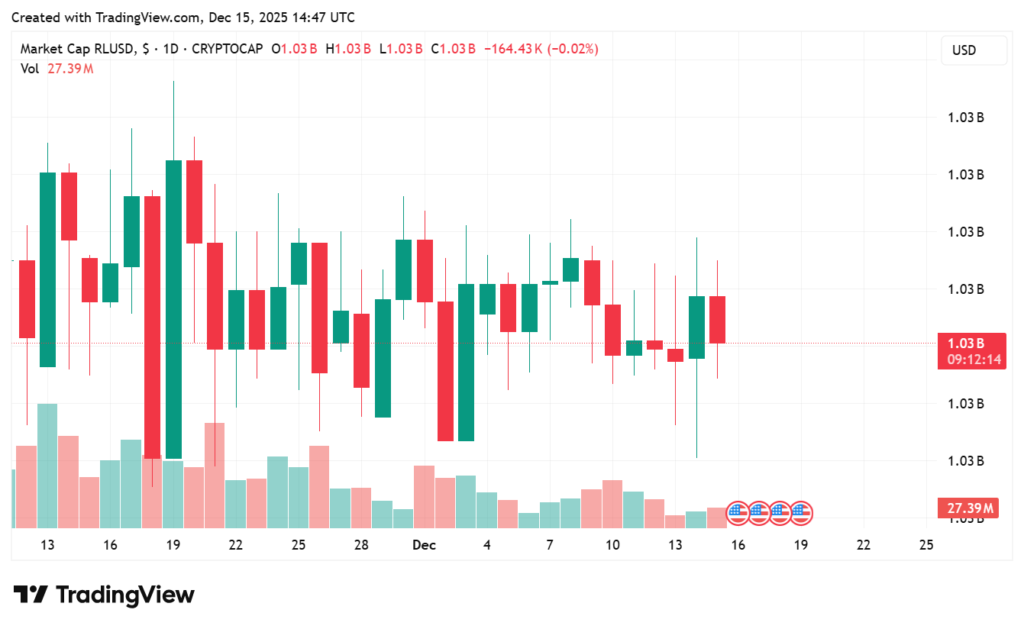
The move marks a significant step in embedding the $1.3 billion stablecoin deeper into the multichain decentralized finance (DeFi) ecosystem. By targeting high-throughput, low-cost Ethereum L2s, Ripple aims to increase RLUSD’s real-world usability for payments, lending, swaps, and institutional-grade DeFi applications.
Suggested: Ethereum Price Prediction 2025–2030: Can ETH Reach $10,000 as Reserves Hit Record Lows?
Wormhole Integration Enables Native Cross-Chain Transfers
Graph Source: TradingView
To support the expansion, Ripple has integrated Wormhole’s Native Token Transfers (NTT) standard. Unlike wrapped or synthetic assets, NTT allows RLUSD to move natively across blockchains while preserving liquidity, compliance controls, and asset integrity.
This design enables RLUSD to function consistently across multiple networks without fragmenting supply, a key requirement for regulated stablecoins operating in DeFi environments.
Recommended: Zcash Price Prediction 2025–2030: Can ZEC Reach $800?
Stablecoins Continue to Bridge TradFi and Crypto
Stablecoins have become a foundational layer of the digital finance ecosystem, linking traditional financial systems with blockchain-based markets. The sector now represents a combined market capitalization of roughly $300 billion, with most tokens pegged to fiat currencies such as the U.S. dollar.
RLUSD was initially launched on Ethereum and the XRP Ledger and is issued under a New York–regulated trust charter. Last week, Ripple also secured preliminary approval for a federal trust bank charter from the Office of the Comptroller of the Currency (OCC). If finalized, this would position RLUSD as the first stablecoin overseen at both state and federal levels in the U.S.
Ripple Positions RLUSD for Institutional DeFi
Commenting on the expansion, Jack McDonald, Ripple’s Senior Vice President of Stablecoin, emphasized the role of stablecoins in driving broader adoption.
“Stablecoins are the gateway to DeFi and institutional participation,” McDonald said. “By bringing RLUSD—the first U.S. trust-regulated stablecoin—to these L2 networks, we’re combining regulatory compliance with onchain efficiency at scale.”
Read This: Why Is Netflix Stock Down? Full Analysis of the 2025 Netflix Stock Crash
wXRP Support Enhances DeFi Utility
In addition to RLUSD, the rollout will also support wrapped XRP (wXRP), allowing XRP holders to participate more easily in DeFi activities across supported L2 networks. Users will be able to swap, lend, or use wXRP alongside RLUSD directly within DeFi applications on networks like Optimism and Base, without needing to bridge back to Ethereum mainnet.
Key Resource: Meta Platforms — Where Does the Stock Stand in Late 2025?
What’s Next
Ripple plans to expand RLUSD to more blockchains in the coming year as regulatory reviews progress. With native cross-chain functionality and growing regulatory clarity, RLUSD is positioning itself as a compliance-focused stablecoin built for a multichain future.
Conclusion
Ripple’s decision to expand its $1.3 billion RLUSD stablecoin to Ethereum layer-2 networks marks a major step toward deeper multichain adoption. By leveraging Wormhole’s native cross-chain technology and targeting high-performance L2s like Optimism and Base, Ripple is positioning RLUSD as a compliance-first stablecoin built for scalable DeFi and institutional use. Pending regulatory approval, the upcoming rollout could significantly enhance liquidity, accessibility, and real-world utility across the broader blockchain ecosystem.
Related Post: Crypto Price Predictions 2025–2030: What Drives the Next Bull Run?
FAQs
What is Ripple USD (RLUSD)?
RLUSD is a U.S. dollar–backed stablecoin issued by Ripple under a New York Department of Financial Services (NYDFS) Trust Charter. It is designed for payments, DeFi, and institutional crypto use cases.
Which Ethereum layer-2 networks is RLUSD expanding to?
Ripple is testing RLUSD on Optimism, Coinbase-backed Base, Kraken’s Ink, and Uniswap’s Unichain, with more networks planned in the future.
How does RLUSD move between blockchains?
RLUSD uses Wormhole’s Native Token Transfers (NTT) standard, enabling native cross-chain transfers without relying on wrapped or synthetic tokens.
When will RLUSD be publicly available on L2 networks?
The public rollout is expected next year, pending regulatory approval from the New York Department of Financial Services (NYDFS).
Why is Ripple expanding RLUSD to Ethereum L2s?
Ethereum layer-2 networks offer faster transactions and lower fees, making them ideal for scaling RLUSD’s use in DeFi, payments, and liquidity applications.
Is RLUSD regulated?
Yes. RLUSD is issued under a NYDFS Trust Charter, and Ripple has also received preliminary approval for a federal trust bank charter from the U.S. Office of the Comptroller of the Currency (OCC).
What role does wrapped XRP (wXRP) play in this expansion?
The rollout supports wXRP, allowing XRP holders to swap, lend, and transact alongside RLUSD on supported layer-2 networks without leaving the chain.
How big is the stablecoin market today?
The global stablecoin market is valued at approximately $300 billion, serving as a key bridge between traditional finance and crypto ecosystems.